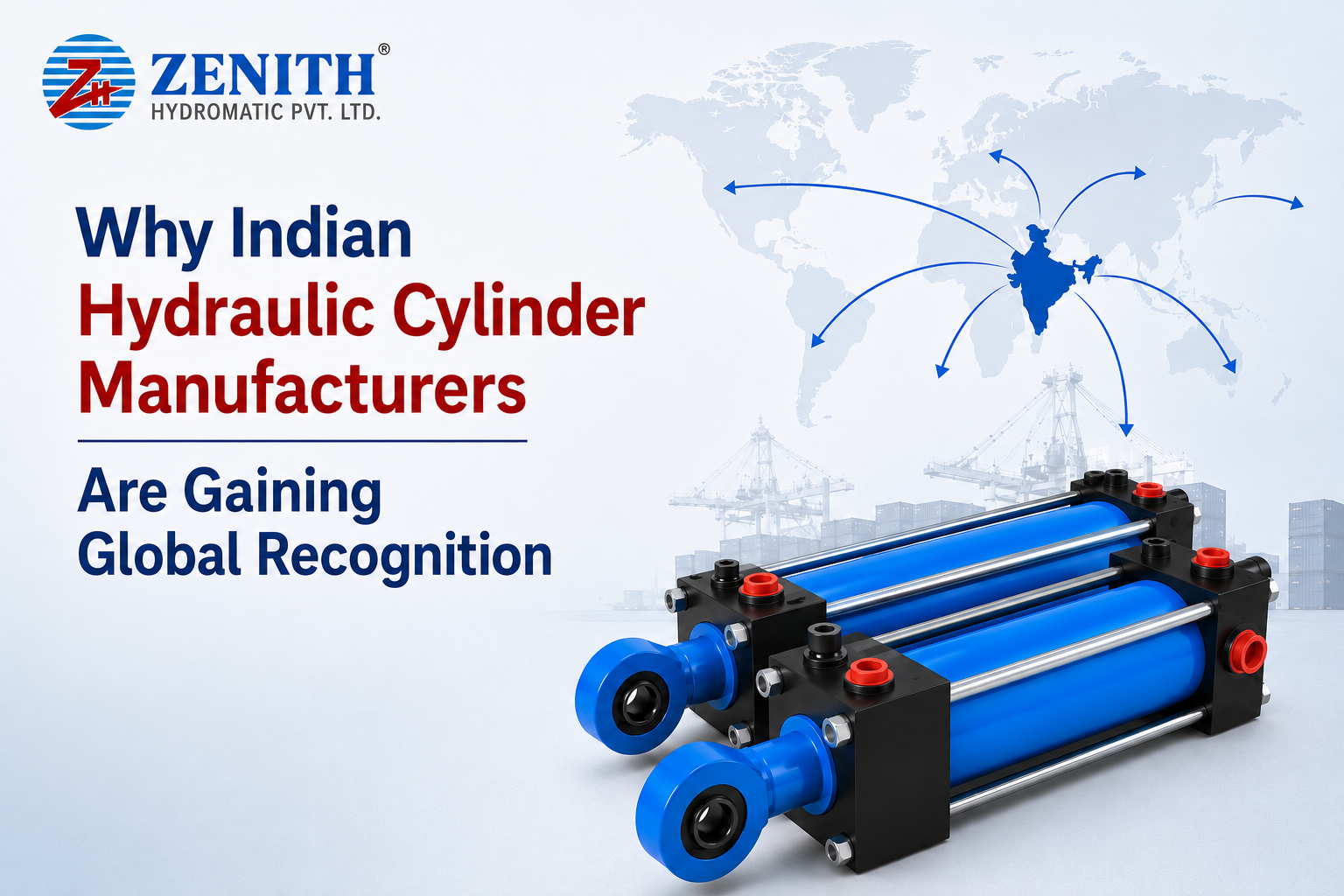
Buyers in Europe, the US, and Southeast Asia used to default to a handful of countries when sourcing hydraulic components. That list is changing. More international OEMs are now placing repeat orders with hydraulic cylinder manufacturers based in India, and the shift isn’t accidental.
It comes down to a mix of lower production costs, stronger quality control, and a growing pool of engineers trained specifically in hydraulics and precision manufacturing.
This article looks at what’s actually driving that recognition, what the export numbers show, and what to check before choosing a supplier.
Table of Contents
- Where India Stands in the Global Hydraulic Cylinder Market
- What’s Driving the Rise of Indian Manufacturers
- How Quality Standards Have Improved
- India vs Traditional Manufacturing Hubs
- What the Export Numbers Show
- Industries Worldwide Sourcing from India
- Challenges Indian Manufacturers Still Face
- What to Look for Before Choosing a Supplier
- FAQs
- Key Takeaways
Where India Stands in the Global Hydraulic Cylinder Market
India isn’t just a low-cost sourcing option anymore. It’s become one of the faster-growing manufacturing bases in the global hydraulics industry.
According to Grand View Research, the global hydraulic cylinder market was valued at $16.82 billion in 2024, and India’s segment of that market is projected to grow at a CAGR of 5.8% through 2030, faster than the global average.
That growth is backed by real demand: construction, agriculture, and material handling sectors within India are expanding, and manufacturers are scaling up to serve both domestic and export orders at the same time.
What’s Driving the Rise of Indian Manufacturers
A few factors explain why buyers who once looked elsewhere are now placing orders with Indian suppliers.
- Cost-competitive manufacturing without cutting corners on core materials
- A large, technically trained engineering workforce familiar with hydraulic design and precision machining
- Government support through initiatives like Make in India, which has pushed investment into domestic component manufacturing
- Wider adoption of international quality certifications, including ISO 9001 and CE marking, on export-facing product lines
- Shorter lead times compared to some established Western suppliers, since many Indian manufacturers handle design, machining, and assembly in-house
How Quality Standards Have Improved
Cost alone doesn’t win repeat international orders. Buyers check quality systems before they check price sheets.
Over the past decade, more Indian manufacturers have adopted ISO 9001 for quality management and CE marking for products headed to European markets. Some have added API and ASME certifications where oil and gas clients require them.
Testing has also improved. Pressure testing, salt-spray corrosion checks, and dimensional inspection using CMM machines are now standard practice at export-focused plants, not an optional extra.
India vs Traditional Manufacturing Hubs
Buyers often compare India against Europe, Japan, or China before placing an order. Here’s roughly how they stack up.
| Factor | India | Europe/Japan | China |
| Manufacturing cost | Low to moderate | High | Low |
| Lead times | Moderate | Longer | Short |
| Custom engineering support | Growing rapidly | Well established | Limited for small orders |
| English-language communication | Strong | Varies | Often limited |
None of this means India wins on every factor. It means the gap that used to exist on quality and engineering support has narrowed enough to make India a realistic option, not just a backup one.
What the Export Numbers Show
Numbers make the trend easier to see than opinions do.
Export data compiled by Volza places India as the world’s second-largest exporter of hydraulic cylinders, with over 69,000 shipments recorded, trailing only China and ahead of the United States. The largest buyers include the US, Poland, and the UK.
That scale of activity doesn’t happen without repeat business. Buyers don’t keep coming back to a supplier unless quality and delivery hold up order after order.
Industries Worldwide Sourcing from India
The demand isn’t limited to one sector. A wide mix of industries now source hydraulic cylinders from Indian manufacturers.
Construction and Earthmoving
Excavators, loaders, and cranes need cylinders that can handle constant, heavy-duty use. Indian manufacturers supplying this segment have had to match international pressure and durability standards to compete for OEM contracts.
Agriculture
Tractors and farm implements are one of India’s largest domestic hydraulic markets, which gives local manufacturers deep, practical experience building cylinders that survive rough field conditions.
Material Handling
Forklifts, stackers, and warehouse lifts require precise, repeatable cylinder performance. Growth in India’s own logistics and e-commerce sectors has pushed manufacturers to refine this segment specifically.
Oil, Gas, and Marine
These sectors demand higher pressure ratings and corrosion resistance. It’s a smaller share of Indian exports today, but manufacturers investing in specialized coatings and testing are starting to win contracts here too.
Winning business in this segment usually takes longer, since qualification processes for offshore and drilling equipment are stricter. Manufacturers who stick with it tend to build long-term, high-value client relationships as a result.
Renewable Energy and Infrastructure
Wind turbine pitch systems, solar tracking equipment, and metro rail projects are newer but fast-growing demand sources within India itself. Manufacturers serving these projects are picking up design experience that also helps them compete for similar work abroad.
Challenges Indian Manufacturers Still Face
Recognition doesn’t mean the industry has no gaps left to close. A balanced view matters here.
- Brand awareness still lags behind established European and Japanese names in some high-precision segments
- Raw material price fluctuations, particularly steel, can affect quoted pricing and delivery timelines
- Infrastructure and logistics costs, while improving, still add to lead times for some regions
- Smaller manufacturers sometimes lack in-house R&D, which limits how quickly they can adapt to unusual specifications
None of these are unique to India, but they’re worth knowing if you’re comparing suppliers on more than just price.
The manufacturers pulling ahead of these challenges are usually the ones investing in their own design teams and testing labs, rather than depending entirely on client specifications.
What to Look for Before Choosing a Supplier
Not every manufacturer that calls itself export-ready actually is. A few practical checks help separate the two.
- Ask for proof of relevant certifications (ISO, CE) rather than taking a claim at face value
- Request sample test reports for pressure and leak testing on your specific cylinder type
- Check whether design and prototyping happen in-house or get outsourced
- Confirm minimum order quantities and realistic lead times in writing
Several established hydraulic cylinder manufacturers in india now offer fully custom builds alongside standard catalog sizes, which is worth asking about if your application doesn’t fit a stock spec.
FAQs
Why are more companies sourcing hydraulic cylinders from India?
Lower production costs, a skilled engineering workforce, and rising quality certifications have made Indian manufacturers more competitive on international orders.
Is India a major exporter of hydraulic cylinders?
Yes. Export data shows India as the world’s second-largest exporter of hydraulic cylinders by shipment volume, behind China and ahead of the United States.
Are Indian hydraulic cylinders as reliable as European or Japanese ones?
Many manufacturers now meet ISO and CE standards and pass the same pressure and durability testing, though brand recognition in some niche, high-precision segments is still catching up.
Which industries buy the most hydraulic cylinders from India?
Construction, agriculture, and material handling account for the largest share, with growing activity in oil, gas, and marine applications.
What should I check before choosing a hydraulic cylinder manufacturer in India?
Verify certifications, ask for sample test reports, confirm whether design work happens in-house, and get lead times and minimum order quantities in writing.
Do Indian manufacturers offer custom hydraulic cylinder designs?
Yes, many now offer custom bore sizes, strokes, and mounting configurations alongside standard catalog products.
How has the Make in India initiative affected hydraulic cylinder manufacturing?
It has encouraged more investment in domestic component manufacturing and pushed several suppliers to upgrade equipment and quality processes to meet export standards.
Key Takeaways
- India’s hydraulic cylinder market is growing faster than the global average, at a projected CAGR of 5.8% through 2030
- India ranks as the world’s second-largest exporter of hydraulic cylinders by shipment volume
- Cost efficiency, skilled labor, and rising certification adoption are the main drivers behind growing global demand
- Construction, agriculture, and material handling remain the biggest buying sectors, with oil, gas, and marine growing steadily
- Brand recognition and raw material costs are still areas Indian manufacturers are working to strengthen
Conclusion
Indian hydraulic cylinder manufacturers didn’t earn their current reputation overnight. It’s the result of steady investment in equipment, certifications, and engineering talent, backed by export numbers that keep climbing.
For buyers comparing suppliers, that combination of cost, capability, and proven volume is hard to ignore.
If you’re evaluating suppliers for your next project, working with an experienced manufacturer like Zenith Hydromatic can help you get a cylinder built to your exact specification without the guesswork.