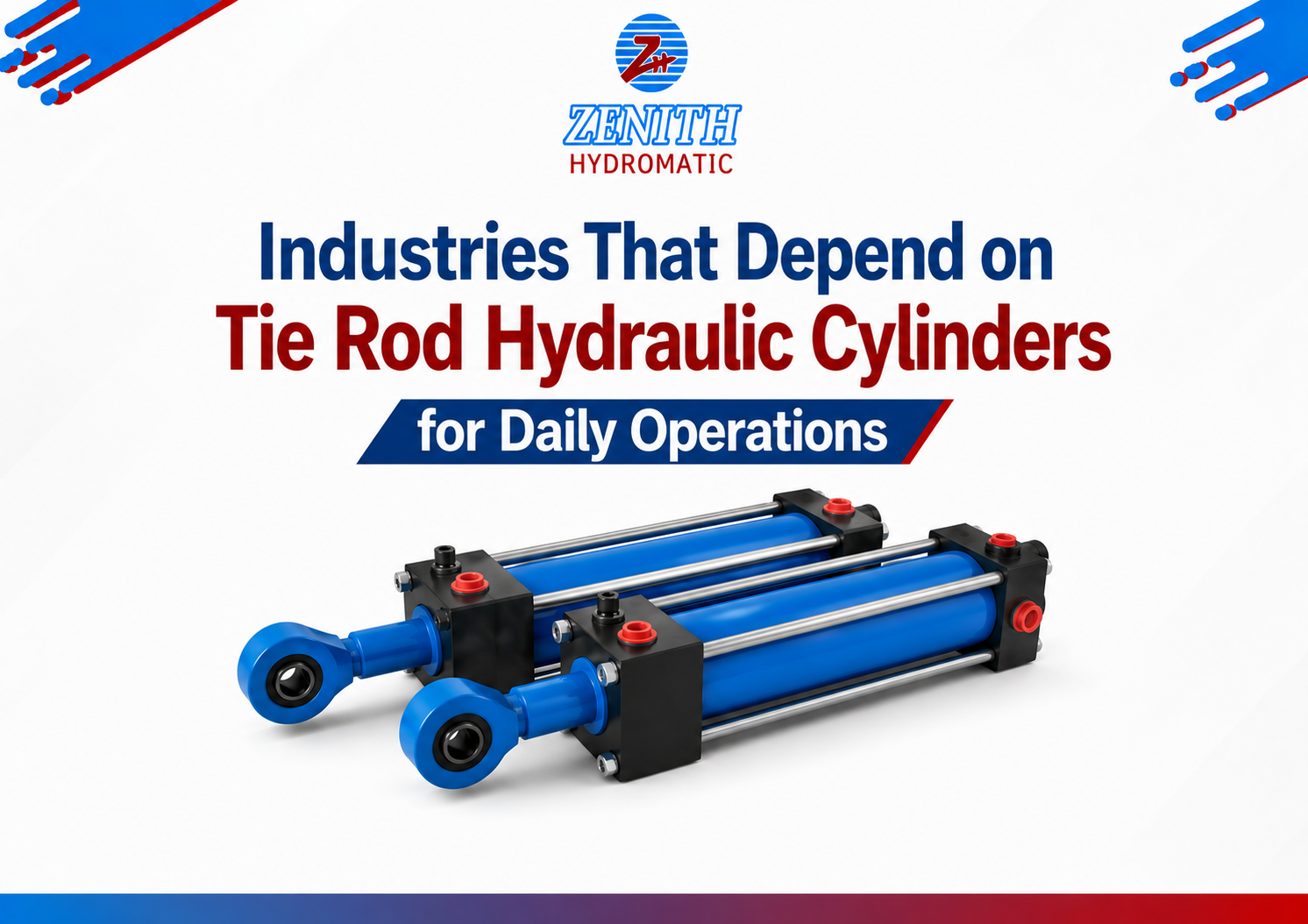
Look inside almost any factory, farm, or construction site and you’ll find a tie rod hydraulic cylinder doing the heavy lifting, literally. It’s one of the most common cylinder designs in industrial use, and there’s a reason it shows up everywhere.
Tie rod cylinders are easy to repair, built from standard parts, and tough enough for high-pressure jobs. That combination makes them the default choice across a surprising range of industries.
This article covers what a tie rod hydraulic cylinder actually is, which industries depend on it daily, and what to check before choosing a manufacturer.
What Is a Tie Rod Hydraulic Cylinder?
A tie rod hydraulic cylinder is a type of hydraulic cylinder held together by external steel rods running the length of the barrel, secured with end caps on both sides. These rods clamp the whole assembly under tension instead of relying on welds.
This design makes the cylinder easy to take apart. When a seal wears out or a piston needs replacing, a technician can open the end caps and rebuild it on-site, instead of scrapping the whole unit.
Why Tie Rod Cylinders Are So Widely Used
Tie rod cylinders aren’t the only option on the market, but they’re usually the first one engineers reach for. A few reasons why:
- Serviceable design: seals, pistons, and rods can be replaced without replacing the whole cylinder
- Standard sizing: bore and stroke dimensions follow common industry standards, so spare parts are easier to find
- Cost-effective manufacturing: the bolted design is cheaper to produce than a welded equivalent
- High pressure tolerance: the tie rods distribute load evenly, which helps the cylinder handle demanding cycles
Demand reflects this. Grand View Research values the global tie rod hydraulic cylinder market at roughly $2.87 billion in 2024, with Asia Pacific as the largest regional market and India expected to post the fastest growth through 2030.
Industries That Depend on Tie Rod Hydraulic Cylinders
With the basics covered, here’s where tie rod cylinders actually get put to work, day in and day out.
Construction and Earthmoving
Excavators, backhoes, loaders, and cranes all use tie rod cylinders for lifting arms, tilting buckets, and steering functions. Job sites are rough on equipment, so the ability to rebuild a cylinder in the field rather than replace it saves real downtime.
Material Handling and Warehousing
Forklifts, pallet stackers, and scissor lifts rely on tie rod cylinders for smooth, controlled vertical movement. Because warehouses run these machines for long shifts, serviceability matters as much as raw strength here.
Agriculture
Tractors, ploughs, balers, and harvesters use tie rod cylinders to raise attachments and adjust working depth in the field. Farm equipment needs parts that are easy to source and repair, since a breakdown during harvest season is costly.
Manufacturing and Industrial Automation
Assembly lines, conveyor systems, and clamping fixtures use tie rod cylinders for repeatable, precise motion. This is actually the largest single application for the cylinder type overall.
Industry data from Future Market Insights shows tie-rod designs are expected to hold close to 39% of the hydraulic cylinder market by product type in 2025, with industrial equipment applications alone accounting for over half of total market revenue.
Automotive and Metal Forming
Stamping presses and vehicle assembly equipment use tie rod cylinders where precise, repeatable force matters. A slight variation in cycle time can throw off an entire production run, so consistency here isn’t optional.
Mining
Crushers, conveyors, and haul truck systems in mining operations run tie rod cylinders under continuous heavy load. Field-serviceable designs are especially valuable here, since remote mine sites can’t always wait for a replacement part to ship in.
Marine and Offshore
Deck cranes, hatch covers, and steering systems on ships and offshore platforms use tie rod cylinders built with corrosion-resistant coatings. Saltwater exposure makes regular seal replacement routine rather than rare.
Oil, Gas, and Power Generation
Valve actuation, drilling rig equipment, and turbine control systems all use tie rod cylinders rated for high pressure and continuous duty. Downtime in this sector is expensive, so field-rebuildable cylinders reduce how long a plant sits idle.
Tie Rod vs Welded Cylinders: Quick Comparison
A common question when specifying equipment is whether to go with a tie rod or welded cylinder. Both do the same basic job, but they suit different situations.
| Factor | Tie Rod Cylinder | Welded Cylinder |
| Repairability | Fully serviceable on-site | Usually needs full replacement |
| Upfront cost | Generally lower | Generally higher |
| Footprint | Slightly larger for same bore | More compact |
| Best suited for | Stationary or accessible machinery | Mobile or space-constrained equipment |
| Typical use | Industrial, agricultural, construction | Mobile hydraulics, tight enclosures |
Choosing the Right Tie Rod Hydraulic Cylinder Manufacturer
Picking the right cylinder design only solves half the problem. The manufacturer behind it determines how well it actually performs over time.
- Ask about seal materials and whether they suit your operating temperature and fluid type
- Check if custom bore, stroke, and mounting options are available, not just catalog sizes
- Confirm testing procedures, especially pressure and leak testing before dispatch
- Look for manufacturers who stock spare seal kits, since availability affects repair turnaround
A number of established tie rod hydraulic cylinder manufacturers offer custom builds alongside standard sizes, which helps when equipment doesn’t fit a catalog spec exactly.
It’s worth asking for reference installations in your specific industry too. A supplier experienced with mining equipment won’t necessarily have the same track record with food-grade or marine applications.
FAQs
What does “tie rod” mean in a hydraulic cylinder?
It refers to the steel rods running along the outside of the cylinder barrel that hold the end caps in place under tension, instead of using welds.
Are tie rod cylinders better than welded cylinders?
Neither is universally better. Tie rod cylinders are easier to repair and often cheaper, while welded cylinders are more compact and suit tight mobile equipment spaces.
How long does a tie rod hydraulic cylinder last?
It depends on operating pressure, duty cycle, and maintenance. With regular seal checks and proper fluid maintenance, many industrial cylinders run for years before needing a rebuild.
Can a tie rod cylinder be repaired instead of replaced?
Yes, that’s one of its main advantages. Technicians can open the end caps, replace worn seals or piston components, and put the cylinder back into service.
Which industries use tie rod hydraulic cylinders the most?
Industrial manufacturing accounts for the largest share of demand, followed by construction, agriculture, material handling, mining, and oil and gas.
What bore sizes are available for tie rod cylinders?
Bore sizes typically range from under 2 inches for light-duty equipment up to more than 4 inches for heavy industrial and construction machinery, though manufacturers can build custom sizes on request.
Do tie rod cylinders work in high-pressure applications?
Yes. Their design distributes load evenly across the tie rods, which allows them to handle high-pressure, high-cycle applications reliably.
Key Takeaways
- A tie rod hydraulic cylinder uses external steel rods instead of welds, which makes it fully serviceable on-site
- Construction, material handling, agriculture, manufacturing, automotive, mining, marine, and oil and gas industries all depend on them daily
- Tie rod designs hold close to 39% of the hydraulic cylinder market by product type, with industrial equipment as the top application
- Compared to welded cylinders, tie rod units cost less and repair easier, but take up slightly more space
- Seal quality, custom sizing, and testing procedures separate a good manufacturer from an average one
Conclusion
Tie rod hydraulic cylinders show up in so many industries because they solve a practical problem: they’re strong enough for heavy-duty work and simple enough to repair without specialist tools.
Whether you’re running a fleet of excavators or a single stamping press, that combination of durability and serviceability is hard to beat.
If you’re sourcing cylinders for your equipment, consulting experienced manufacturers like Zenith Hydromatic can help you match the right specification to your application and avoid costly guesswork.